Marco's DSAR: a Tuesday email, a 12-hour engineering job, and 30 seconds on Eurobase
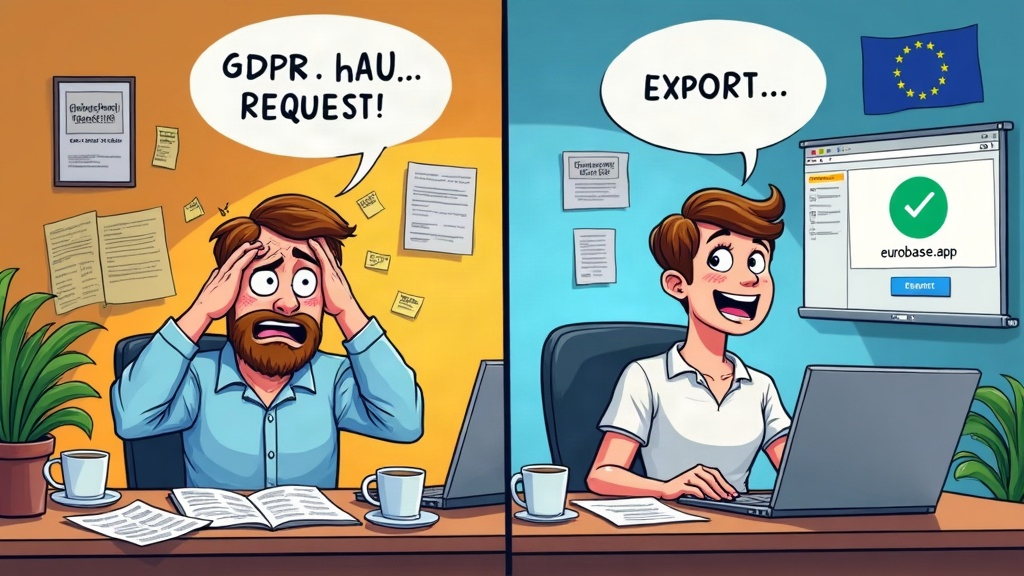
The Tuesday email
Marco runs product at a small EU fintech — five people, a mobile app, a payments backend, a few thousand paying customers. On a Tuesday morning he opens an email from one of them:
> Hi, under Article 15 of the GDPR, please send me a copy of all the personal data you hold about me.
Perfectly polite. Perfectly legal. Statutory response window: 30 days.
He forwards it to his CTO, who sighs.
The old workflow (8-12 hours, and it costs about $1,500)
Here is what the CTO's checklist actually looks like, on a stack that isn't Eurobase. Every SaaS team that has ever answered a DSAR by hand has written some version of this:
1. Log into the database. Write a SELECT on the users table by email. Get the user_id.
2. Walk every table with a user_id column. Transactions. Notifications. Support tickets. Session logs. Device tokens. Preferences. Referrals. Consent records. Each one gets its own query, its own CSV. On a mature app, that is a dozen tables. Miss one and the DSAR is incomplete — which is itself a GDPR violation.
3. Check storage. Did the customer upload an ID document during KYC? A profile picture? A signed contract PDF? aws s3 ls, filter by user prefix, download.
4. Scrub anything that shouldn't be exported. Internal notes on the support tickets. Other customers' rows that leaked into a JOIN. The GDPR gives the data subject their data — not everyone else's.
5. Format it. GDPR Article 20 says machine-readable and commonly used. So JSON or CSV, not a screenshot. Zip it.
6. Set up a secure download link that expires. You can't email 40 MB of PII as an attachment. So a signed S3 URL with a 7-day expiry.
7. Log the request in the RoPA. Article 30 says you have to keep a record of every processing activity — including the DSAR fulfilment itself. Google Doc, spreadsheet, whatever.
8. Log the export in the audit trail. Who exported the data? When? From which IP? If a regulator ever asks whether Marco's team has appropriate access controls, this is the evidence.
9. Send it. Secure channel, not personal email.
Industry surveys put the average cost of one DSAR at around $1,500 — 8-12 hours of engineering time, plus a bit of legal review. Volume is up 246% in the two years to 2024. Marco's five-person team can absorb one a quarter. Five a month is a full engineer's week gone every quarter.
The Eurobase workflow (30 seconds, one click)
Marco doesn't call the CTO. He opens the console.
1. Projects → Compliance tab → Request Single-User Export.
2. Searches for the customer by email (or pastes their user UUID).
3. Picks JSON or CSV, clicks Export User Data.
The console does what the CTO's checklist did for the rows part — atomically, in one operation:
- ▸The auth record. Email, sign-in history, MFA state.
- ▸Every tenant table with a
user_idcolumn. Eurobase auto-discovers those tables at export time (DiscoverUserTables) and pulls the rows keyed to that customer — across every table with the right shape, no re-plumbing per DSAR. - ▸Retention holds naming this subject — filtered so no other subject's identifiers leak (Article 15(4) compliance detail most homegrown exports miss).
- ▸Presigned download link, 1-hour expiry — Marco downloads it, verifies, then attaches or re-hosts for the customer via whatever secure channel his team already uses.
Two side effects, both required, both automatic:
- ▸The Article 30 RoPA row is created —
export_type=article_15, subject_email, timestamp, exported_by (Marco's platform user ID). Rate-limited to 1 export per user per 24 hours. - ▸The audit log is stamped — actor, IP, timestamp, file size. Hash-chained so a future export can't be back-dated without breaking the chain.
What's out of scope today (worth flagging honestly): storage-object walk for the subject's uploaded files, and packaging the export into a customer-facing HTML index. Both are on the roadmap; the rows + auth + retention-hold path is what actually ships, and it's the load-bearing part of Article 15 anyway.
Cost: 30 seconds and one click.
Two weeks later: the DPA request
Same customer emails back:
> Great, thanks. Now I also need your Data Processing Agreement and a list of every sub-processor that touches my data.
On the old workflow: Marco's team keeps a Google Doc "sub-processor list" that is usually out of date because nobody updates it when a new tool gets added. Someone from legal reviews it before sending. Two or three days.
On Eurobase: Compliance tab → Article 30 report → Download PDF.
The report is regenerated from live project configuration on every download. Every sub-processor Eurobase uses is listed with:
- ▸Region flag (EU/US)
- ▸CLOUD-Act exposure flag (green/amber/red)
- ▸Purpose ("email delivery", "SMS OTP", "managed Postgres", etc.)
- ▸What data reaches them ("email address only", "no PII", "encrypted-at-rest DB backups")
No stale spreadsheet. No legal-review anxiety. Marco hands it over. Done again.
Why this matters
DSAR volume up 246% in two years. Every EU SaaS is on the hook — not just the big ones. Miss a request or fumble the format and the supervisory-authority risk is up to €20 million or 4% of global annual turnover, whichever is higher.
Every other backend platform makes GDPR your problem. You write the SQL. You maintain the sub-processor doc. You audit your own audit log.
Eurobase ships the compliance stack as a first-class platform feature — DSAR, RoPA, hash-chained audit log, sub-processor registry. Not middleware you assemble. Not a spreadsheet you maintain. Marco's team gets back the eight hours to build the product they were hired to build.
Try it yourself
- ▸Sign up — the Compliance tab is on your first project.
- ▸Read the DSAR feature page for the technical shape.
- ▸Take the free GDPR Backend Readiness Assessment — 10 questions, 3 minutes, no signup. Scores your current backend against the ten obligations that actually get audited.